LiPo (lithium polymer) batteries power almost all FPV quads. They store a lot of energy for their weight and deliver the high currents that four motors draw at full throttle, which is why race quads use them instead of NiMH packs.
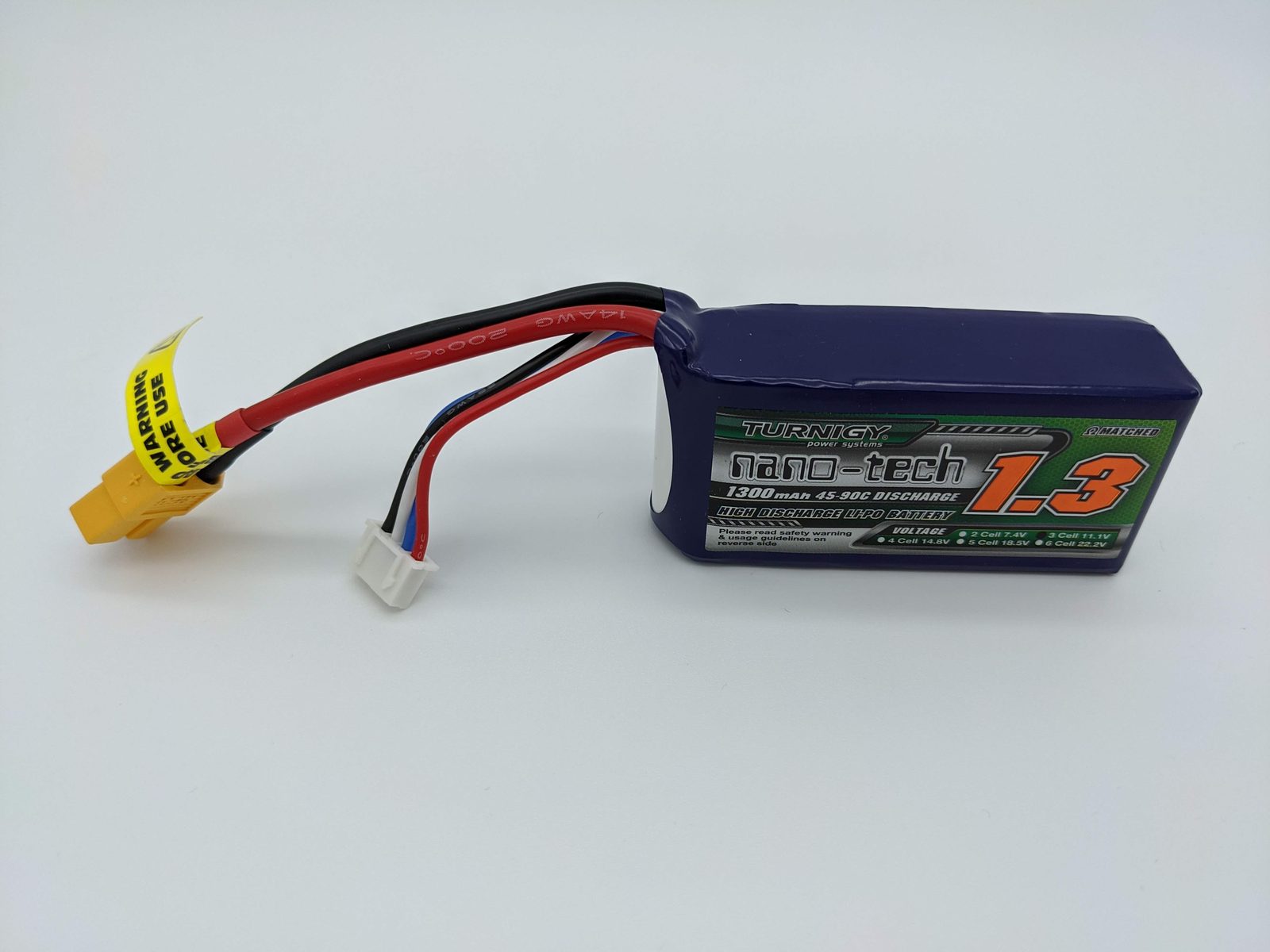
Cell Count and Voltage
A LiPo pack consists of cells connected in series. The number of cells is written with an S, so a 3S pack has three cells. The voltage of a cell depends on its state of charge:
| State | Voltage per cell | 3S pack |
|---|---|---|
| Fully charged | 4.2 V | 12.6 V |
| Nominal | 3.7 V | 11.1 V |
| Storage | 3.8 V | 11.4 V |
| Land (under load) | about 3.5 V | about 10.5 V |
| Damaged below | 3.0 V | 9.0 V |
The glossar lists the nominal voltages of other cell counts. The cell count determines how fast the motors spin, because a brushless motor turns at about $K_v$ times the voltage without load. The EMAX RS2205 2300 $K_v$ motors of this build reach about 25 500 RPM on a 3S battery. A battery with more cells needs motors with a lower $K_v$ for the same RPM.
Capacity and C-Rating
The capacity $Q$ is given in milliampere hours (mAh). A 1300 mAh battery can deliver 1.3 A for one hour. Together with the voltage it gives the stored energy, for a 3S 1300 mAh pack:
\[E = U \cdot Q = 11.1\,\text{V} \cdot 1.3\,\text{Ah} \approx 14.4\,\text{Wh}\]A larger capacity allows longer flights, but it also makes the battery heavier.
The C-rating tells how much current a battery can deliver continuously, as a multiple of its capacity:
\[I_{\max} = C \cdot Q\]The Turnigy nano-tech 1300 mAh pack is rated 45 to 90 C, which means $45 \cdot 1.3\,\text{A} = 58.5\,\text{A}$ continuously and up to 117 A in short bursts. Manufacturers’ C-ratings are often optimistic. The internal resistance $R_i$ of the cells is a better measure: under load the voltage drops by $I \cdot R_i$, so a current of 60 A causes a drop of 0.3 V per cell at an internal resistance of 5 mΩ. This voltage sag grows as a battery ages.
Connectors
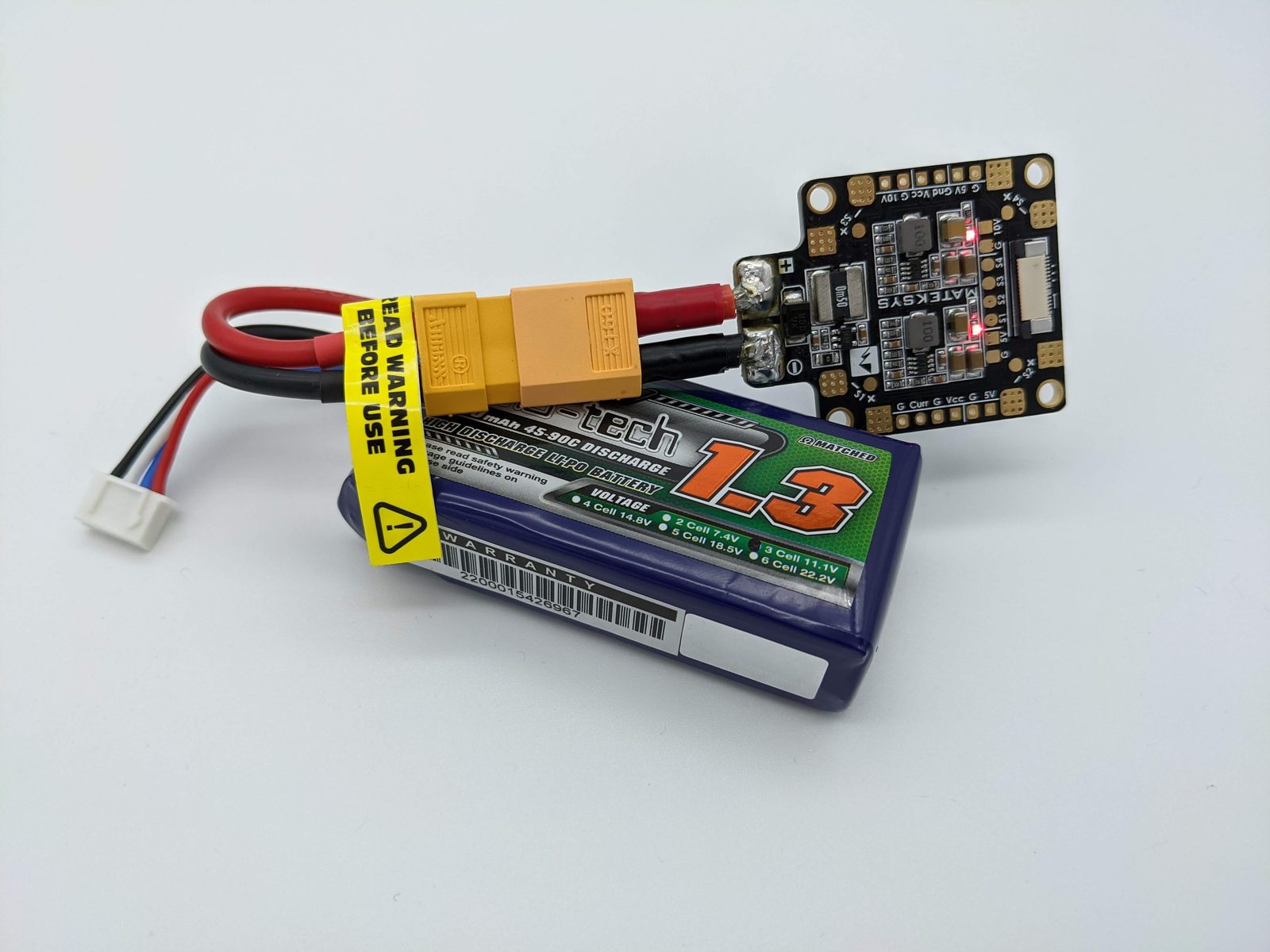
- Main lead: the XT60 plug carries the current to the power distribution board. Its shape makes reversed polarity impossible.
- Balance lead: the white JST-XH plug has one pin more than the battery has cells, four pins on a 3S pack. The charger uses it to balance the cells, and a battery checker uses it to measure each cell.
Charging, Storage and Safety
- Charge LiPos only with a balance charger, by default at 1C, see Charger and Testers.
- If a battery won’t be used for more than a few days, charge or discharge it to the storage voltage of 3.8 V per cell. Fully charged batteries age faster.
- Charge on a non-flammable surface or in a LiPo bag and never leave a charging battery unattended.
- Don’t charge or fly batteries that are puffed or damaged, for example after a crash.
- Dispose of old batteries at a battery collection point, not in the household waste.
Batteries of this Build
The parts list links a Lumenier 1300 mAh 3S 60C battery with an XT60 plug, which can deliver $60 \cdot 1.3\,\text{A} = 78\,\text{A}$ continuously. The photos on this page show a Turnigy nano-tech 1300 mAh 3S pack with the same capacity, cell count and plug.
Comments