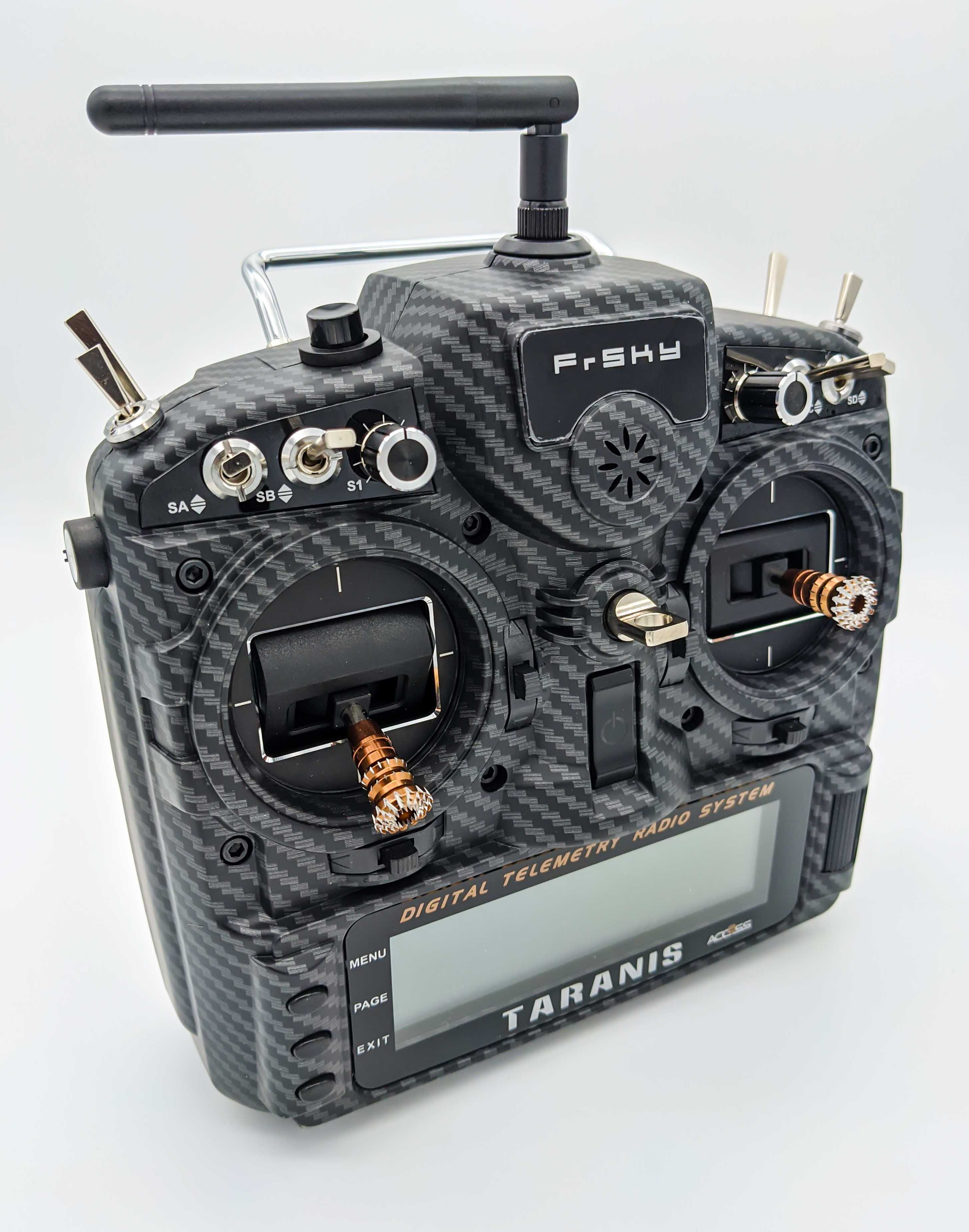
The RC transmitter, also called radio, is what the pilot holds in the hands. It reads the sticks and switches and sends them to the receiver on the quad. This build uses the FrSky Taranis X9D Plus SE 2019.
Stick Modes
The two sticks control throttle, yaw, pitch and roll. Which stick controls what is defined by the stick mode:
| Mode | Left stick | Right stick |
|---|---|---|
| Mode 2 | Throttle (up and down) and yaw (left and right) | Pitch (up and down) and roll (left and right) |
| Mode 1 | Pitch (up and down) and yaw (left and right) | Throttle (up and down) and roll (left and right) |
Mode 2 is the most common mode for FPV quads. The throttle stick has no spring that centers it, so it stays where it is left.
Firmware
The radio runs a firmware that acts as its operating system. It defines models, mixes, switches, throttle curves and telemetry screens, and it runs Lua scripts such as the Betaflight Lua script. The Taranis of this build runs OpenTX. Most radios today run its successor EdgeTX, which also supports the Taranis X9D Plus 2019, see the Taranis page.
Internal and External Modules
The radio link is created by an RF module. The Taranis X9D Plus 2019 has an internal ISRM module, which speaks FrSky’s ACCESS and ACCST D16 protocols. On its back it also has a JR module bay for external modules, for example for TBS Crossfire or ExpressLRS. This way the radio can be used with other receivers without replacing it.
Pages in this Section
- Taranis X9D Plus SE 2019: firmware, bootloader and internal module
- Receiver binding R-XSR: receiver firmware, registration and binding
- Throttle curves
- RC rate and expo settings
- Telemetry
- PID Lua script
Comments